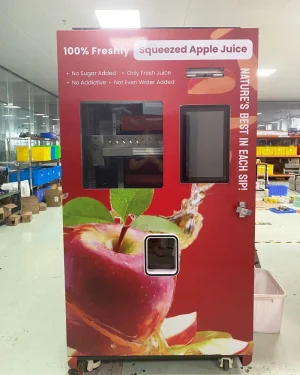


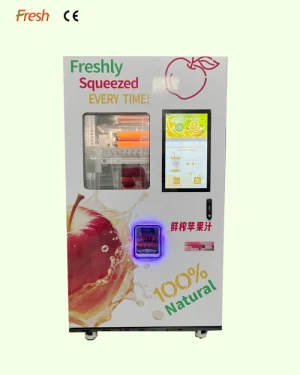


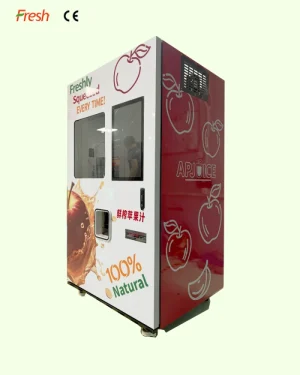
Consumption upgrading is not an abstract concept; it is a vote by wallets. Market data shows that the fresh juice category grows at 20% annually, while bottled juice stagnates at around 1%. Consumers are willing to pay 30% more for freshly pressed apple juice than for bottled alternatives. The reason is straightforward: taste.
Bottled juice must undergo pasteurization and homogenization to extend shelf life, which destroys volatile aromatic compounds in apples. Cold-pressed fresh juice retains pulp fiber and natural enzymes. The crisp acidity and dense pulp texture upon tasting cannot be replicated by any industrial product.
Nutritional evidence is equally compelling. Vitamin C degrades by approximately 10% per hour after exposure to air. Bottled juice takes at least 72 hours from factory to shelf. In contrast, an unattended vending machine goes from pressing to consumption in under 90 detik. Another advantage of unmanned operation is the price point. By eliminating store rent and staff salaries, a 300ml cold-pressed apple juice can be priced at $2.80, which is only 60% of the cost at a manual fresh juice shop. This makes frequent consumption possible, rather than an occasional luxury.
Core Parameters Explained: 5 Technical Indicators to Check Before Buying an Apple Juice Vending Machine
When purchasing equipment, the numbers on the spec sheet directly determine your daily revenue ceiling. Ignore the following five indicators, and your operations will be at a disadvantage from the start.
Apple capacity. Entry-level models hold 10kg of apples, roughly 40 apel, producing about 60 cangkir per hari. Commercial models hold 30kg, supporting peak demand of over 120 cangkir. Before selecting a model, estimate the average daily foot traffic at your chosen location, then work backward to determine the required capacity.
Production time. Single-cup cold pressing takes anywhere from 45 ke 90 detik. A 45-second model can serve nearly twice as many customers during morning rush hours. Namun, the juicing components wear out faster, and the blade replacement cycle shortens from 6 months to 4 bulan. This is a direct trade-off between speed and maintenance cost.
Power and energy consumption. The refrigeration system is the main power consumer. A 1.2kW unit running 24/7 consumes about 8 kWh per day. At an industrial electricity rate of $0.15/kWh, the monthly electricity bill is approximately $36. If the machine is placed outdoors, you must also consider the heating and insulation module, which raises energy consumption to 1.8kW.
Anti-browning technology. Once an apple is cut, polyphenol oxidase reacts with air and causes browning within 3 menit. High-end models use nitrogen flushing in the chamber to reduce oxygen concentration to below 2%, preserving juice color for up to 6 jam. Mid-range models rely on a vitamin C coating pre-treatment for apples, which is cheaper but slightly compromises flavor.
Payment system. Domestic operations must support WeChat Pay and Alipay. Overseas markets require compatibility with Visa, Mastercard, and local e-wallets. Some models also support facial recognition payment, but this adds 15% to hardware costs. Choosing a model that supports remote switching of payment channels leaves room for future expansion.
Return on Investment: How a Single Machine Can Achieve Payback Within a Year
Let us start with a rough calculation. The equipment purchase price ranges from $5,500 ke $6,815. Adding installation, logistics, and the first month’s fruit inventory, the initial investment is about $7,500. If placed in a shopping mall corridor with an average daily foot traffic of 5,000 rakyat, and assuming a 2% conversion rate, daily sales would be about 50 cangkir.
The revenue model is as follows: daily revenue of 50 cups × $2.80 = $140, monthly revenue of $4,200. On the cost side: apples account for about 30% of total costs ($1,260), electricity $36, maintenance amortization $50, payment processing fees about 3% ($126), and location rent at 15% of revenue ($630). Monthly net profit is approximately $2,098, yielding a net profit margin of about 50%.
Based on this, the static payback period is $7,500 − $2,098 ≈ 3.6 bulan. Namun, this is an ideal scenario. Sensitivity analysis shows that if sales drop by 20% ke 40 cangkir per hari, monthly net profit falls to $1,478, extending the payback period to 5.1 bulan. If sales halve, the payback period exceeds 8 bulan.
Different scenarios vary significantly. School locations have winter and summer vacation gaps, leaving only 9 months of effective operation per year, so the actual payback period must be multiplied by 1.33. Gym locations, on the other hand, are stable year-round, and consumers there have a higher willingness to pay for healthy beverages, allowing a price increase to $3.20. Choosing the right location is more important than choosing the equipment.
Don’t Be Fooled by High Margins: 5 Hidden Costs and Operational Pitfalls of Fresh Juice Vending Machines
A 50% net profit margin is indeed attractive, but that is a book figure. In real operations, five hidden costs will quietly erode your profits.
First, fruit spoilage rates can reach 15%. Bruising and rot during transportation and storage, as well as jams caused by customer misuse, all lead to direct waste. In our tests, spoilage rates can spike to 20% in high summer temperatures.
Second, cleaning is not free. The juicing components need to be disassembled and cleaned every 12 jam, with each cleaning taking 20 menit. If operators do it themselves, the time cost is often underestimated. If hiring someone, at $15 per hour, the monthly cleaning cost is about $90.
Third, downtime losses. The average downtime due to juicer motor failure is 48 jam. At a daily revenue of $140, a single failure costs $280, not including repair fees. Choosing a brand with a local service network can reduce response time to 8 jam.
Fourth, location errors are the biggest silent cost. We have seen too many operators place machines in high-traffic areas where the target audience does not match—for example, at the entrance of a senior community. Sales are only 30% of expectations, and the payback period stretches indefinitely.
Fifth, payment processing fees. Mobile payment platforms typically charge between 2.5% Dan 3.5%. This seems small, but with a monthly revenue of $4,200, the annual loss exceeds $1,500. Negotiating with payment service providers to reduce the rate to below 2% is the most direct way to boost profits.
From Installation to Profit: A Daily Maintenance and Fruit Supply Chain Management Checklist for Operators
Buying the machine is just the beginning. A mature operational system determines whether the equipment becomes a money printer or a decoration.
Daily maintenance (10 menit): Check the juice outlet for blockages, clean the drip tray, and wipe the touchscreen with food-grade disinfectant wipes. Also, check the refrigeration temperature to ensure it stays below 4°C.
Weekly maintenance (40 menit): Disassemble the juicing auger and filter, use a dedicated brush to remove fiber residue, and soak them in a citric acid solution to descale. Check the fruit bin for rotten apples and remove them promptly.
Monthly maintenance (2 jam): Replace the activated carbon filter, check the refrigerant pressure, and calibrate the load cells. Blade wear inspection is also done at this stage, with replacement if necessary.
The fruit supply chain is another lifeline. Signing annual supply agreements with local orchards locks in prices and also allows you to get a 20% discount on grade-out fruit that is cosmetically imperfect but flavor-intact. One operator in Hangzhou used this strategy to reduce fruit costs from 35% ke 25% of total costs, lowering overall operating costs by 10%.
IoT remote monitoring systems can significantly reduce manual inspection frequency. Built-in sensors transmit real-time data on inventory levels, refrigeration temperature, and fault codes. Operators only need to check the backend, eliminating daily site visits. Peak restocking plans also rely on data—sales on Friday afternoons and before holidays are typically 40% higher than usual. Restocking the fruit bin a day in advance prevents direct losses from stockouts.
Customization and Brand Empowerment: How to Stand Out in a Red Ocean
As apple juice machines become more common on the streets, appearance becomes the first competitive barrier. Shell customization costs range from $800 ke $3,000, depending on the painting process and materials. A machine with a brand IP image has much higher recognition than a plain model, and the extra sales generated can easily cover the customization cost.
LED screens are another revenue stream. Installing a 55-inch display on top of the machine not only plays brand advertisements but also allows you to rent out ad space to nearby merchants. In prime commercial areas of first-tier cities, the monthly rental for ad space on a single machine can reach $300, directly offsetting the location rent.
Software-level customization is equally important. Operators can choose a white-label remote management platform to manage multiple machines under their own brand, adjusting prices and recipes in real time. OEM services go a step further, allowing modifications from fruit bin capacity to juicing structure, with a minimum order quantity typically of 10 unit. Data feedback is also crucial—the backend sales curve will tell you that 3 PM to 5 PM is a sales trough. Pushing a second-cup-half-price promotion during this period can effectively boost off-peak revenue.
The industry is moving from automation to intelligence. AI-based restocking prediction systems have proven their value in real operations. By integrating weather forecasts, holiday calendars, and local event schedules, the system can adjust restocking plans 48 hours in advance. An operator in Shenzhen adopted this system and reduced stockout rates from 12% ke 3%, while also cutting fruit spoilage.
Remote diagnostics enable machines to self-report faults. When sensors detect abnormal motor torque, the system automatically generates a work order and notifies maintenance personnel, reducing average repair time to 6 jam. Personalized recommendations are also on the horizon. The machine identifies repeat customers through a membership system and recommends apple varieties with different sweetness levels based on their purchase history.
Sustainability is becoming a new competitive dimension. Biodegradable PLA cups and energy-saving sleep modes (with standby power consumption reduced to 0.3W) are gradually becoming standard. The unmanned retail equipment market in the Asia-Pacific region is expected to grow at a compound annual growth rate of 11%, with AI-capable models capturing the high-end share. There is still a window of opportunity to enter now; in two years, it will be a red ocean.