آلات بيع عصير التفاح الطازج: What They Are and How They Work

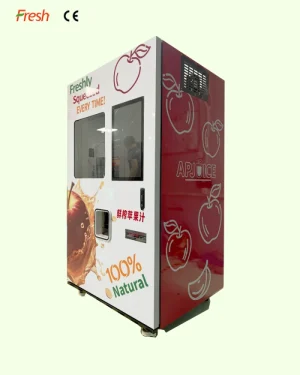
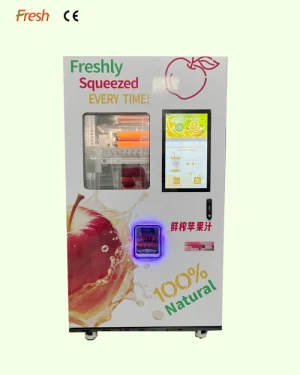
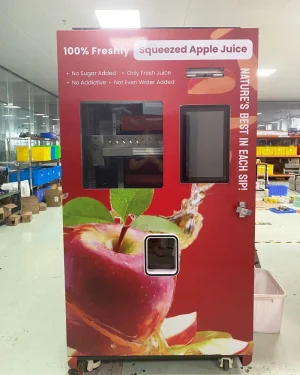
An automatic fresh apple juice vending machine compresses the entire traditional juice‑making process into a metal cabinet about 1.5 meters tall. According to the 2023 industry report by the European Vending Association (EVA), the installed base of such equipment in Europe has exceeded 4,200 units, with a compound annual growth rate of 18%. They require no staff, no water tap—just a power outlet and about 2 square meters of floor space.

What Actually Happens Inside the Machine

The entire juicing process starts when you press the "Start" button on the touchscreen, taking an average of 90 ثواني. The internal sequence is fixed: the refrigerated compartment (temperature maintained at 4°C) releases 3 ل 5 apples into the washing tank, then the apples fall into a stainless‑steel screw press. The press separates pulp from juice at 60 revolutions per minute; the juice flows directly into a disposable cup, while the pomace is pushed into a separate waste bin—with a capacity sufficient for about 120 cups before it needs emptying. Take the Dutch brand JuiceBOT's JB‑2000 model as an example: its waste‑bin full sensor automatically lights up 10 cups before it is completely full. This means operators typically refill apples every 3 days and clear pomace every 5 أيام, depending on daily sales volume.

Core Components and Real Costs

The hardware composition of a machine is not complex, but the choice of each component directly determines maintenance costs.

Stainless‑steel juicing unit

The cutting disc and filter screen are wear parts. For domestic models (e.g., Shenzhen HZS‑9), the filter needs replacement after about 8,000 أكواب, costing around $50 per change; German‑made WMF commercial models can last up to 15,000 أكواب, but the filter costs 2.3 times as much.

Refrigeration unit

Rated power is typically between 280W and 450W. Based on China's commercial electricity rate of $0.11/kWh, a machine running 24/7 costs about $0.95 per day in electricity, accounting for 5% ل 9% of the gross profit per cup (priced at $1.70–$2.50).

Payment system

All new models after 2021 support QR‑code payments. Research data from Japan's Sanden shows that in Tokyo subway station juice vending machines, mobile payments already account for 73%, coin payments only 19%, and transit cards the remaining 8%. Here is a counter‑intuitive point: although the machine looks "fully automatic," apple variety selection is the most frequently manually intervened link. Fuji apples have a juice yield of about 68%, while Gala apples only 61%—the former lowers cost per cup by $0.06, but insufficient acidity can affect taste. Most operators use a 7:3 blend to balance cost and flavor.

Key Differences from Other Juice Equipment

These machines are most often compared with pre‑packaged juice vending machines. The latter have no juicing mechanism and are essentially refrigerated shelves, costing 40% less to purchase, but per‑cup profit is also lower—the gross margin of pre‑packaged juice is about 35%, while freshly squeezed apple juice maintains a stable gross margin of 62% ل 70% (source: Japan Juice Vending Association 2024 annual report). One common misconception needs clarification: it does not require an external water connection. The cleaning process uses recirculated water from a built‑in tank; each automatic cleaning cycle consumes about 1.5 liters of water, and the tank capacity is designed at 30 لتر, meaning operators only need to manually refill water every two weeks. This is fundamentally different from fresh‑brew coffee machines (which need water supply and drainage) or some mixed‑juice machines (which require a drain connection). What the data does not tell you is the failure rate. According to spot checks by the German Technical Inspection Association (TÜV), such equipment experiences an average of 2.3 unscheduled downtimes per year, of which 62% are related to apple jams in the juicing mechanism. This means that when choosing a location, operators must consider at least two inspection visits per week—this is the most easily overlooked hidden cost beyond the purchase price.

الأسئلة المتداولة: Everything Buyers Ask Before Committing

How many apples can the machine hold?

The hopper capacity is 250 ل 280 قِطَع, depending on the size of the fruit. Smaller apples (like a 2.5-inch diameter) pack tighter, so you will fit closer to 280; larger ones (3 بوصة) will fill at around 250. The machine is calibrated to handle both without jamming, but you should not mix sizes in a single load.

How many cups of juice can be produced from 250–280 apples?

Expect roughly 120 cups from a full load of 250 التفاح, and more than 100 cups if you load 280 larger ones. The output varies by apple variety—Honeycrisp yields more juice per pound than Granny Smith due to higher water content.

How do I maintain and clean the machine?

يوميًا: wipe down the dispense nozzle and drip tray with a food-safe sanitizer. أسبوعي: run the automatic cleaning cycle, which flushes the juice lines with a citric acid solution. Monthly: descale the internal water tank and replace the air filter. The entire weekly deep clean takes about 25 دقائق. Skip it, and you will notice a sour smell within two weeks.

What are the power requirements?

A standard 110V or 220V outlet with a dedicated 15-amp circuit is sufficient. The machine draws 500–800W during the pressing cycle and less than 50W on standby. Do not share the circuit with a refrigerator or other high-draw appliance.

Does the machine support cashless payments?

نعم. All modern units accept credit/debit cards and mobile wallets. Some models also accept prepaid campus cards or loyalty tokens. Ask for the payment system brand—Crane or Nayax are the most reliable—and confirm the merchant account fees before signing a contract.