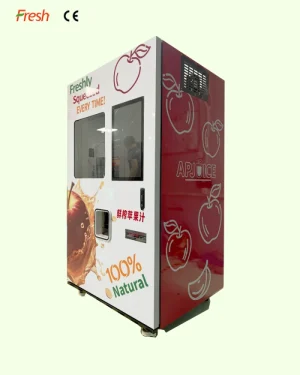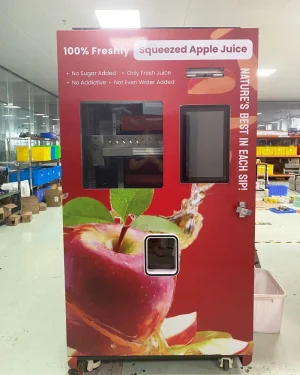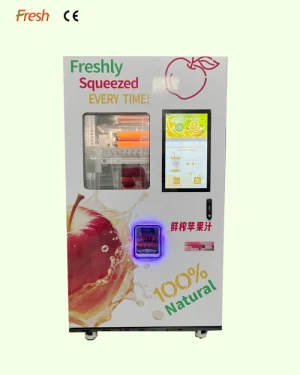
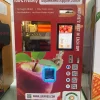

This is a fully automated fresh apple juice vending machine engineered for unattended retail in high-traffic venues. It delivers 100% fresh, unpasteurized apple juice with no additives, no concentrates, and no preservatives. From the moment a customer selects their cup size to the moment juice is dispensed, the entire process takes 40 초. The machine presses whole apples on-site, grinding and squeezing them in a cold-press cycle that preserves flavor and nutritional integrity.
The defining feature is the 21.5-inch touchscreen. It serves as the primary user interface, allowing customers to customize cup size, view the pressing process in real time, and receive their order status. 운영자용, that same screen becomes a high-resolution advertising platform. You can run video ads, display nutritional information, 또는 기계가 작동하는 동안 다른 제품을 교차 홍보. 화면의 운영 체제는 원격 콘텐츠 업데이트를 지원합니다., 숙소를 방문하지 않고도 홍보 자료를 변경할 수 있습니다..
표준 주스 자동 판매기는 종종 사전 포장된 주스나 농축액 혼합에 의존합니다.. 이 장치는 그러한 타협을 제거합니다. 사과는 냉장 호퍼에 보관했다가 주문이 접수된 경우에만 프레스에 공급됩니다.. 갈변 방지 질소 플러싱 시스템은 주스의 색상과 맛을 최대 1시간 동안 유지합니다. 24 시간, 몇 시간 내에 주스가 분해되는 경쟁사에 비해 중요한 이점. 이 기계를 쇼핑몰에 배치하세요., 회사 사무실, 피트니스 센터, 또는 대중교통 허브. 수행원이 필요하지 않습니다., 자동으로 결제 처리, 프리미엄 가격대를 정당화하는 프리미엄 제품을 생산합니다..
Technical Specifications and Dimensions
Physical dimensions are 800 mm (너비) x 800 mm (깊이) x 1800 mm (키). The unit weighs 280 kg and is constructed with a powder-coated steel frame and tempered glass panels. It operates on a 220V/50Hz single-phase power supply with a maximum power consumption of 1200W. The machine is rated for continuous operation between 5°C and 35°C ambient temperature, with an IP54 weatherproofing rating for the exterior casing.
사과 호퍼는 다음을 견뎌냅니다. 70 중간 크기 사과 (approximately 4 liters of finished juice). The refrigerated juice tank maintains the pressed juice at 4°C until dispensed. A separate waste compartment collects apple pomace and peels, with a capacity of 30 liters.
The 21.5-inch touchscreen operates at 1920×1080 resolution with a capacitive touch panel rated for 10 million touches. The onboard computer runs on a quad-core processor with 4GB RAM and 32GB storage. Connectivity options include Wi-Fi (802.11 b/g/n), 4G LTE via an optional SIM card slot, and an Ethernet port for wired networks.
Payment system compatibility covers cash (coins and bills), credit and debit cards (EMV chip and magnetic stripe), and mobile payments (Apple Pay, Google Pay, Alipay, WeChat Pay). The machine supports both online and offline payment processing with a store-and-forward mechanism for connectivity interruptions. The water supply is self-contained; the machine uses an internal 5-liter water tank for the cleaning cycle, requiring manual refilling every 2-3 days depending on usage.
Anti-Browning Technology: How It Works and Why It Matters
Fresh apple juice turns brown within minutes of pressing. The culprit is polyphenol oxidase, an enzyme that reacts with oxygen in the air. This reaction darkens the juice and degrades its flavor. Most vending machines on the market accept this limitation, producing juice that must be consumed within 4 시간. This machine does not.
The system uses a two-stage approach. First, the pressing chamber is flushed with food-grade nitrogen gas before and during the extraction cycle. Nitrogen is heavier than oxygen, so it displaces the air and creates an inert atmosphere around the juice. Without oxygen, the oxidation reaction cannot proceed. The nitrogen flushing cycle runs automatically for 8 seconds before each press and continues during the 40-second extraction.
Second, the juice is immediately chilled to 4°C in a stainless steel cooling coil before entering the storage tank. Low temperature slows the residual enzymatic activity to a near standstill. The combination of oxygen displacement and cold temperature extends the juice’s shelf life to 24 hours without any preservatives or heat treatment. Pasteurization is deliberately avoided because it destroys the delicate volatile compounds that give fresh apple juice its aroma and complexity.
The result is a product that looks, smells, and tastes like it was pressed moments ago — because it was. For the operator, this means less waste. Juice that sits unsold for 8 hours is still marketable, unlike on competitor machines where it must be discarded. A simple diagram of the cycle: hopper → washing chamber → nitrogen-flushed press → cooling coil → refrigerated tank → dispensing nozzle. Each stage is monitored by sensors that log data to the cloud for quality control.
비즈니스 ROI: 투자회수 기간 및 수익성 분석
The capital investment for this machine is $6,300. The payback period depends on daily sales volume, cup pricing, and operating costs. Consider a base scenario: 50 cups sold per day at an average price of $5 컵당. That yields $250 일일 수익에서. Operating costs include apples (approximately $0.80 컵당), electricity (~에 대한 $2 하루에), location rent (varies, assume $300 매월), and maintenance (budget $100 매월).
| Scenario | Cups/Day | Daily Revenue | Monthly Net Profit | Payback Period |
|---|---|---|---|---|
| Conservative | 30 | $150 | $1,020 | 14 개월 |
| Average | 50 | $250 | $2,120 | 10 개월 |
| Best Case | 80 | $400 | $3,720 | 8 개월 |
These figures assume a 70% utilization rate of the apple hopper per day. The conservative scenario reflects a low-traffic location; the best case reflects a busy mall or gym. Compare this with a coffee vending machine. Coffee machines typically generate $3-$4 per cup with a lower ingredient cost, but they require daily bean refills and frequent descaling. The apple juice machine’s ingredient cost is higher per cup, but the product commands a premium price. Fresh juice sells for $5-$7 in retail settings, so a $5 vending price is competitive.
Revenue streams extend beyond direct sales. The 21.5-inch screen can be sold as advertising space. A local business paying $200 per month for a rotating ad slot reduces your payback period by approximately 2 개월. The machine’s remote telemetry system tracks inventory and sales in real time, allowing you to optimize restocking schedules and identify underperforming locations quickly.
Maintenance and Cleaning Procedures for Daily Operations
Daily maintenance takes 10 분. The hopper must be rinsed with clean water to remove apple residue and dust. The juice tank requires a flush with a food-grade sanitizer solution, followed by a fresh water rinse. The dispensing nozzle should be wiped with a disinfectant cloth. The touchscreen needs a daily wipe with a microfiber cloth to remove fingerprints and smudges.
The machine runs an automated self-cleaning cycle after every 20 cups dispensed. This cycle flushes the pressing chamber and juice lines with hot water (65℃) for 90 초, followed by a cold water rinse. The cycle is triggered automatically and does not require operator intervention. If the machine is idle for more than 2 시간, it initiates a partial cleaning cycle to prevent bacterial growth in the lines.
Weekly maintenance requires 30 분. The pressing unit must be disassembled for a deep clean. This involves removing the auger, screen, and juice collection tray, then scrubbing them with a brush and food-safe detergent. Inspect all rubber seals for wear and replace them if they show signs of cracking. Check the nitrogen tank pressure (if using an external supply) and verify the cooling system’s condenser coils are free of dust.
| Task | Frequency | Time Required |
|---|---|---|
| Hopper rinse | Daily | 3 min |
| Juice tank flush | Daily | 5 min |
| Screen wipe | Daily | 2 min |
| Self-cleaning cycle | 모든 20 컵 | Automatic |
| Press unit deep clean | Weekly | 30 min |
| Seal inspection | Weekly | 5 min |
The machine’s remote diagnostics system monitors component health and alerts you via SMS or email when a part is nearing failure. This reduces on-site service calls by identifying issues before they cause downtime. The system also tracks cleaning cycle completion and logs the data, which is useful for compliance with local health regulations.
- How does the anti-browning technology work?
- Nitrogen gas flushes the pressing chamber to displace oxygen, preventing oxidation. The juice is then chilled to 4°C to slow enzymatic activity. This dual approach keeps the juice fresh for 24 hours without preservatives.
- What is the average payback period?
- Based on 50 cups sold per day at $5 컵당, the payback period is 10 개월. Conservative estimates (30 cups/day) extend it to 14 개월; high-traffic locations (80 cups/day) can achieve payback in 8 개월.
- Can it accept credit cards and mobile payments?
- 예. The machine supports EMV chip cards, magnetic stripe cards, and mobile wallets including Apple Pay, Google Pay, Alipay, and WeChat Pay. Cash payments are also accepted.
- What maintenance is required daily?
- Approximately 10 분: rinse the hopper, flush the juice tank with sanitizer, wipe the dispensing nozzle, and clean the touchscreen. The machine runs an automatic self-cleaning cycle every 20 컵.
- How many cups can it serve per day?
- The machine can produce up to 150 cups per day on full capacity, limited by the 70-apple hopper and the need for periodic cleaning. ~에 40 seconds per cup, throughput is not the bottleneck; apple supply and cleaning cycles are.
- Is it suitable for outdoor use?
- 예, with conditions. The IP54 rating protects against dust and water splashes. The operational temperature range is 5°C to 35°C. For outdoor installations in colder climates, an optional heating kit is available to maintain the internal temperature above the minimum threshold.
- 보증 기간은 무엇입니까?
- The machine carries a 2-year comprehensive warranty covering parts and labor. The compressor and touchscreen are covered for an additional year. Remote diagnostics support is included for the first year at no charge.
Contact us for a quote or to discuss bulk pricing for multiple units. We can provide a site assessment to determine optimal placement and projected sales volume for your specific location.