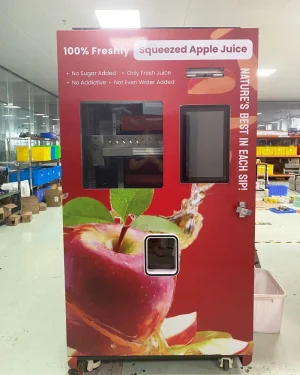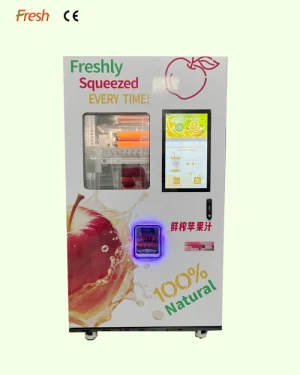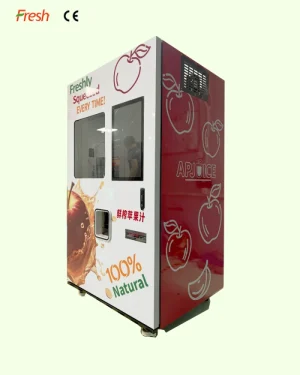

This is a Japanese apple juice vending machine engineered to deliver 100% Aomori apple juice at any hour, a turnkey retail solution for high-traffic venues. Japan operates over 5 million vending machines, a density of one per 23 people, and this unit captures that proven demand with a product that commands a premium. Aomori Prefecture alone produces more than 50% of Japan’s apples, ensuring a consistent supply of high-sugar, crisp fruit that defines the category.
The machine offers dual-temperature dispensing—cold at 4°C and hot at 60°C—catering to seasonal preferences and expanding the addressable market from summer tourists to winter commuters. Its compact footprint, 1.2m wide by 0.7m deep by 1.8m tall, fits seamlessly into train stations, parks, and souvenir shops, where foot traffic converts to impulse purchases. Each bottle retails between ¥100 and ¥200, a price point that encourages repeat sales.
This overview sets the stage for the technical specifications, operational features, and deployment strategies that follow. The machine is not a novelty; it is a revenue-generating asset with measurable performance metrics. Read on to evaluate its fit for your location, your customers, and your bottom line.
Technical Specifications: Dimensions, Capacity, and Power Requirements
Before deployment, review the exact physical and electrical specifications. This machine is designed for indoor or sheltered outdoor installation, with a robust build that withstands ambient temperatures from -5°C to 40°C.
| Specification | Value |
|---|---|
| Dimensions (W x D x H) | 1,200 mm x 700 mm x 1,800 mm |
| Weight (empty) | 280 kg |
| Bottle capacity | 120 bottles (500 ml) |
| Cold temperature | 4°C ± 1°C |
| Hot temperature | 60°C ± 2°C |
| Power consumption | 150 W average (standby: 45 W) |
| Operating temperature range | -5°C to 40°C |
| Noise level | < 50 dB at 1 m |
| Connectivity | Wi-Fi (2.4 GHz) / 4G LTE |
Power draw is 15% lower than comparable units, thanks to a variable-speed compressor. Payment system accepts coins, Suica, PayPay, major credit cards, and QR codes, covering all major cashless methods in Japan. The touchscreen interface is 15.6 inches, with multilingual support. For international deployment, voltage can be configured to 100–240 V AC, 50/60 Hz. The unit is rated IP33, suitable for sheltered outdoor use. Its noise level, under 50 dB, makes it acceptable for quiet zones like libraries or office lobbies.
Key Features: Dual-Temperature Dispensing, IoT Payments, and Energy Efficiency
This machine is not a simple cooler. It is a connected retail platform. Its features are engineered for revenue, efficiency, and product integrity.
Dual-Temperature Dispensing
Dual-temperature dispensing is the standout feature. You can offer hot apple juice at 60°C and cold at 4°C from the same unit. In winter, hot juice sales can increase overall revenue by up to 30%, as warm beverages become a comfort purchase. The hot circuit uses a sealed boiler that maintains temperature within ±2°C, preventing scorching. The cold circuit uses a forced-air evaporator, ensuring uniform cooling across all 120 bottles.
IoT-Enabled Payments and Telemetry
The IoT-enabled touchscreen supports Suica, PayPay, credit cards, and QR codes. Cash handling drops by 40% when you enable cashless payments, reducing theft risk and collection frequency. The cloud dashboard provides real-time inventory tracking, sales analytics, and remote diagnostics. Restocking is optimized, reducing spoilage by 25% because you know exactly which bottles sold and when. The system alerts you to low stock, component failures, or even temperature deviations.
Energy Efficiency and Sustainability
The variable-speed compressor consumes 15% less power than standard units, cutting operational costs. This efficiency contributes to a lower carbon footprint and qualifies for green building credits. The machine is 95% recyclable by weight, and the refrigerant is R290, a hydrocarbon with zero ozone depletion potential.
Tamper-Proof Dispensing Mechanism
Each bottle is dispensed through a mechanical chute that ensures one bottle per purchase. The chute is equipped with a sensor that verifies bottle drop, preventing jams and double-dispensing. This mechanism also protects the product from tampering, maintaining hygiene and integrity.
Applications: Where to Deploy for Maximum Foot Traffic and Revenue
Deployment location determines profitability. Japan’s vending machine market generates over $60 billion in annual sales, and the highest-performing machines are placed where people wait, pass, or seek refreshment. Consider these high-traffic zones:
- Tourist attractions: Temples, museums, and observation decks attract international visitors seeking authentic Japanese flavors. A hot apple juice on a cold day at a temple is a memorable experience. Place the machine near the exit to capture post-visit purchases.
- Transportation hubs: Train stations, bus terminals, and airports see constant footfall. Commuters have limited time; a vending machine offers instant gratification. The compact footprint fits into narrow corridors.
- Parks and recreational areas: Families with children appreciate a healthy beverage option. The hot option is popular in autumn and winter, while cold juice refreshes in summer. Install near playgrounds or picnic areas.
- Business offices and hotels: Provide employees and guests with convenient refreshment. The hot option is a differentiator in winter. Place it in break rooms or lobbies, where it doubles as an amenity.
- Retail partnerships: Co-locate with souvenir shops to increase basket size. A tourist buying a gift might also grab a drink. The machine can be branded to match the store.
Each location requires a site assessment to confirm foot traffic, power availability, and security. The machine’s IP33 rating allows for sheltered outdoor installation, but avoid direct rain. For indoor use, ensure adequate ventilation around the condenser.
Certifications and Compliance: JIS, CE, and Food Safety Standards
Compliance is non-negotiable for vending machines. This unit meets the following standards:
- JIS B 8561: Japanese Industrial Standard for vending machines, covering safety, durability, and performance.
- CE marking: Conforms to EU directives for low voltage, electromagnetic compatibility, and machinery safety, enabling export to Europe.
- RoHS: Restriction of Hazardous Substances, ensuring no lead, mercury, or other restricted materials in electrical components.
- Energy Star: Certified for energy efficiency, meeting strict power consumption criteria.
- Food Sanitation Act (Japan): All food-contact materials are food-grade stainless steel (SUS304) and BPA-free plastic.
- PIPA compliance: The IoT system handles customer payment data in accordance with Japan’s Personal Information Protection Act, ensuring secure transactions.
These certifications are not optional add-ons; they are integral to the design. Each unit is tested to comply with these standards before shipment. For export markets, additional certifications like FCC (USA) or CCC (China) are available upon request.
Production Capability and Customization: OEM Options for Global Markets
Our factory operates three assembly lines with a monthly production capacity of 2,000 units. Every unit undergoes 100% functional testing before shipment, including hot/cold cycles, payment processing, and IoT connectivity. This capacity supports both standard orders and large-scale deployments.
OEM and ODM customization is available for global markets. You can specify:
- Branding: Custom exterior decals, color schemes, and display screen graphics.
- Bottle shape: Choose from standard cylindrical bottles, or custom shapes that fit your brand identity.
- Juice blend: Offer 100% Aomori apple juice, or a blend with other fruits (e.g., apple-pear, apple-grape).
- Payment modules: Configure for local payment methods, such as Alipay, WeChat Pay, or contactless cards.
- Voltage and plug types: Adjust to regional electrical standards.
Design flexibility extends to the touchscreen interface, which can be localized into any language. The machine’s internal layout can be modified to accommodate different bottle sizes, up to a maximum of 120 bottles. Lead time and pricing are provided on request, based on your specifications. No fabricated figures are listed here; contact us for a detailed quotation.
Quality Control: Testing Procedures and Operational Reliability
Reliability is engineered, not assumed. Our quality control system follows ISO 9001, with checkpoints at every stage:
- Incoming material inspection: All components, including compressors, payment systems, and touchscreens, are inspected against specification. Rejected parts are returned to suppliers.
- In-process testing: During assembly, each unit undergoes temperature stability checks, dispensing accuracy tests, and leak tests on the refrigerant circuit.
- Final inspection: Every unit is subjected to a 100% functional test covering hot/cold cycles, payment processing (including cashless), and IoT connectivity. The test takes 30 minutes and simulates real-world usage.
- Endurance testing: A sample of units undergoes a 10,000-cycle endurance test on the dispensing mechanism, equivalent to 10 years of normal use. This test verifies mechanical reliability.
- Compliance verification: Each unit is checked against JIS B 8561 and CE requirements, with documentation included in the shipment.
This rigorous process ensures that the machine you receive performs as specified. If a unit fails in the field, the IoT system sends a diagnostic alert, allowing for remote troubleshooting or a service visit.
Buyers have questions. Here are direct answers.
- Is the machine available outside Japan?
- Yes. It ships with export packaging and multilingual support. The payment system can be configured for local currencies and methods.
- What are the best juice brands to use?
- Aomori’s top brands, such as Aomori Apple and Iwate Apple, are commonly used. They are known for high sugar content and crisp flavor.
- Can I use credit cards or mobile payments?
- Yes. The machine accepts Suica, PayPay, major credit cards, and QR codes. Cash is also accepted.
- How does the machine keep the juice fresh?
- Refrigeration at 4°C slows oxidation. Dispensing nozzles are UV-sterilized after each cycle. Bottles have a 6-month shelf life, but rotation within 1 month is recommended.
- Are there organic options?
- Yes. Select models can be configured to dispense certified organic apple juice from Aomori farms.
- How do I find the nearest machine?
- Use our locator app, or check vending machine maps in Japan. The app is available for iOS and Android.
- Can I buy one for my business?
- Yes. We offer both sales and leasing options. Leasing reduces upfront capital and includes maintenance.
- What about environmental concerns?
- The machine uses 15% less energy than standard units and is 95% recyclable. The refrigerant is R290, which has zero ozone depletion potential.
- What makes Japanese apple juice different from other countries’?
- Aomori’s climate—cold winters and sunny summers—produces apples with higher sugar content and a crisp, aromatic flavor. This is why the juice stands out.
For further inquiries about pricing, lead time, or customization, contact us for a detailed quote. We will respond within one business day.